

Key takeaways
- Never put fats, oils or grease down the disposal or the sink. Charleston Water System and InSinkErator both say so 16.
- Hot water does not help. Charleston Water System says grease separates out and settles even when mixed with hot water 2.
- Small amounts of grease go in a sealed container in the trash. Used cooking oil can go to a Charleston County staffed convenience center, from residential households only 35.
- Stringy scraps like celery and banana peel are the foods InSinkErator says its Standard models cannot grind 7.
- A humming disposal is jammed. Switch it off, use the wrench in the bottom center hole, then press the red reset button 14.
- At Blue Collars, diagnosis starts at around $150 and most fixture repairs, disposals included, land around $300 to $800. These are typical ranges from past work, not a quote and not a guarantee 1112.
What stays out of the disposal this Thanksgiving
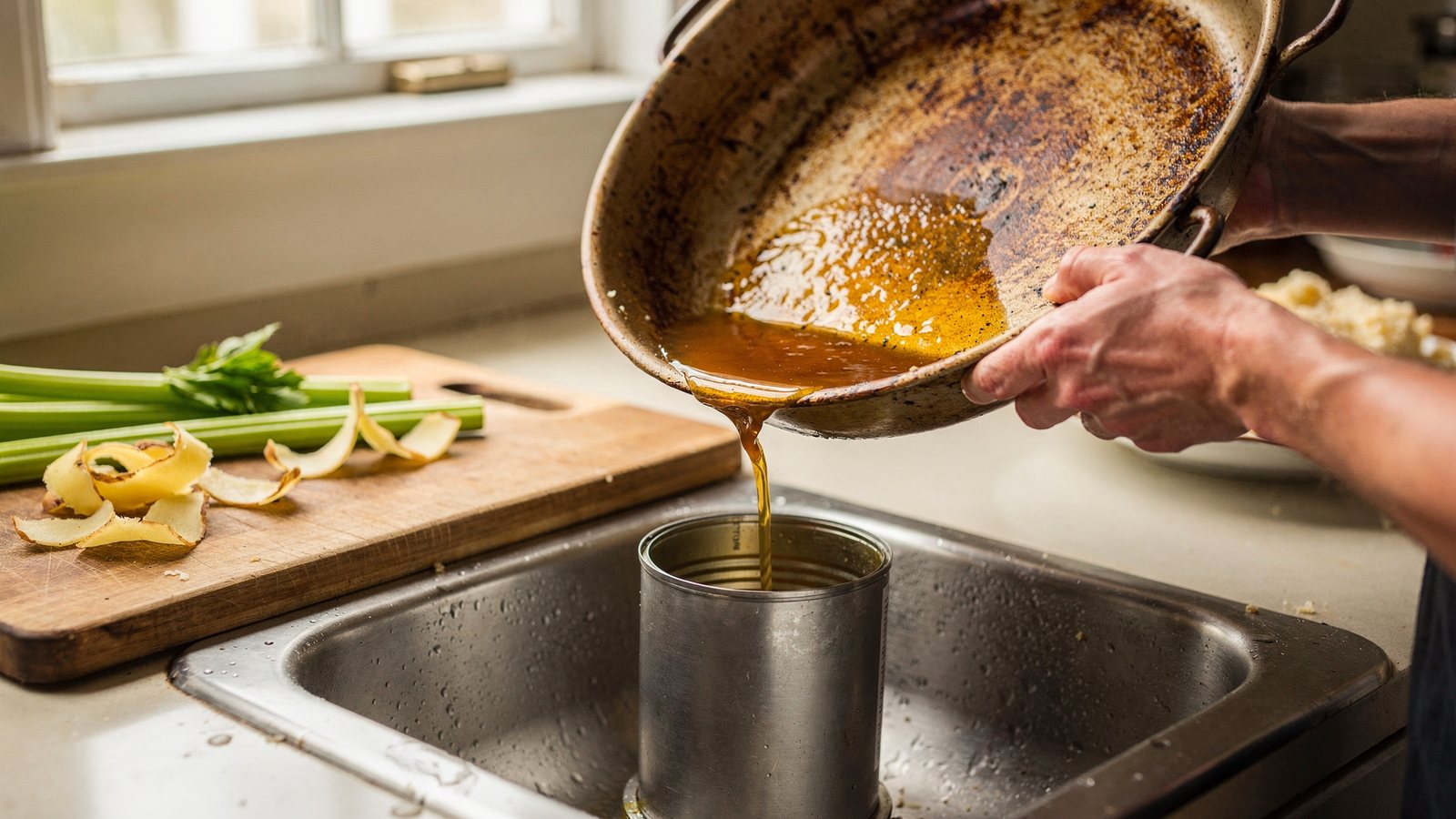
Keep fats, oils and grease, stringy fibrous peels like celery, and large amounts of starchy scraps out of the garbage disposal. Charleston Water System names fats, oil and grease as one of the two biggest causes of sewer clogs, and says hot water does not help because the grease separates out and settles. Let grease cool in a container and put it in the trash, or take used cooking oil to a Charleston County staffed convenience center.
Thanksgiving falls on Thursday, November 26 this year 13. It is the one day a year when most kitchens cook a large bird, several starchy sides and a pan of drippings in the same afternoon. That combination is hard on a disposal and harder on the pipe behind it.
The utility is direct about it. Charleston Water System's do-not-flush guidance says the two biggest causes of sewer clogs are "flushable" wipes and "fats, oil and grease (FOG)" 1. Its FAQ adds that grease hardens as it cools, and that "Even when mixed with hot water, the grease will separate out and settle in plumbing systems and sewer lines" 2. The instruction that follows is simple: pour it into a container and put it in the trash 3.
The manufacturer agrees on grease. InSinkErator, one of the largest disposal makers, says to "never place any type of fats, oils, grease in a garbage disposal, or down a sink drain for that matter" 6.
Here is the short version for the day itself.
| Thanksgiving item | Disposal? | Where it goes instead |
|---|---|---|
| Turkey drippings, fryer oil, butter, gravy fat | No | Cool it, seal it in a can or jar, trash it; or take cooking oil to a county convenience center |
| Celery, onion skins, corn husks, banana peels | No | Trash or compost |
| Potato peels in bulk | Small amounts only | Trash most of the pile |
| Turkey carcass and large bones | No | Trash, or the stock pot first |
| Plate scrapings, small meat scraps, small bones | Yes, a little at a time | Disposal with cold water running |
| Eggshells and coffee grounds | Yes, gradually | Disposal with a strong flow of cold water |
The rest of this guide explains each line, where Charleston and Columbia residents can take used cooking oil, how to clear a jammed disposal safely in the middle of the meal, and what a repair costs if it comes to that.
The Thanksgiving foods that cause the trouble
The foods that cause disposal and drain trouble on Thanksgiving fall into three groups: grease from the turkey and the sides, stringy fibrous vegetable scraps, and large volumes of starchy peels fed in at once. Grease is the one the utility and the manufacturer both rule out completely. Fibrous scraps wrap around the grinding parts. Starchy peels in bulk turn into a paste that settles in the drain line.
Grease is the clear one. Turkey drippings, the fat skimmed off gravy, bacon fat from the green beans and the oil from a turkey fryer are all fats, oils and grease, and every source in this guide says the same thing about them 126.
Fibrous scraps are the second group. InSinkErator says its Standard Series models "can grind any food apart from stringy and fibrous materials such as banana peel, celery and rhubarb" 7. On Thanksgiving that list grows to include celery from the stuffing, onion skins, corn husks and the stringy ends of green beans. The fibers wrap around the grinding parts instead of breaking down.
Starchy peels are the third group, and the issue is volume. A few potato peels are ordinary food waste. A sink full of them from ten pounds of mashed potatoes is a different load: the starch turns into a thick paste that the disposal pushes into the drain faster than water can carry it away. Put most of the pile in the trash.
Bones are where the usual advice is wrong. InSinkErator's FAQ lists bones, with meat and dairy, among the foods its disposals can take 7. That means meal scraps. A turkey carcass is a different thing entirely and belongs in the trash, or in the stock pot first.
Disposal humming and not spinning? Book a garbage disposal repair.
Why hot water does not carry grease away
Running hot water while pouring grease down the sink does not wash it out to the street. Charleston Water System says grease hardens as it cools and that, even when mixed with hot water, it will separate out and settle in plumbing systems and sewer lines. The hot water only moves the problem a few feet further along, into the pipe inside your wall or under your yard.
Fats, oils and grease, which utilities shorten to FOG, are liquid when they are hot and solid once they cool. Charleston Water System puts it plainly: "Grease cools as it travels through pipes" 1.
So the hot water trick works for the length of pipe the water stays hot. Past that point the grease cools, separates from the water and sticks to the pipe wall. The next load of grease sticks to the first. The utility says that over time the buildup "can severely reduce the capacity of a pipe or block it completely, sometimes resulting in sewer back-ups or overflows" 2.
The disposal makers point the same way. InSinkErator's FAQ says food waste is fed into a disposal with cold water 8, and for coffee grounds and eggshells it recommends a strong flow of cold water to help flush them through the pipes 6.
This is also why the problem shows up in the days after the meal rather than during it. The grease went down warm on Thursday. It is a solid band in the drain line by the weekend.
Where Charleston's cooking oil and grease should go
Small amounts of grease go in the trash: let it cool in a can or jar, seal it, and throw it away, which is exactly what Charleston Water System asks residents to do. Larger amounts of used cooking oil, such as the oil from a turkey fryer, can go to a Charleston County staffed convenience center, which accepts cooking oil from Charleston County residential households.
For the drippings and pan fat, the utility's instruction is the whole answer. Pour the grease into a container and put it in the trash 3. A coffee can, a glass jar with a lid, or the can the vegetables came in all work. Let it cool first so it does not melt through a trash bag.
Turkey fryer oil is a bigger job, often several gallons. Charleston County's Environmental Management Department lists cooking oil as accepted at its convenience centers, from Charleston County residential households only and not business waste 5. In its 2023 holiday notice the county said used cooking oil can be dropped off at one of its eight staffed convenience centers 4.
Check the holiday hours before you load the car. That same 2023 notice said the staffed convenience centers closed on Thanksgiving Day and the day after, and reopened on the Saturday 4. The 2026 schedule may differ, so confirm with the county at (843) 720-7111 4.
Columbia has its own option. The City of Columbia's grease page says city residents can take grease to 2910 Colonial Drive, where it is turned into biofuel for city vehicles, and asks everyone else to pour cooled grease into a jar or can and put it in the trash 910. That page carries no date, so call the city before you drive over.
Why the utilities care about your drain
Grease that leaves your house does not disappear; it becomes a cost the utility pays to clear and passes back through sewer fees. The City of Columbia says it spends an average of $1.5 million a year and 4,500 hours clearing its wastewater collection lines, and that those costs reach customers through sanitary sewer fees. Charleston Water System lists grease as one of its two biggest causes of sewer clogs.
The City of Columbia puts numbers on it. Its fats, oils and grease page says the city spends "an average of $1.5 million annually" and 4,500 hours clearing wastewater collection lines, and that the cost is passed on through sanitary sewer fees 9.
Charleston Water System makes the same point without a dollar figure. Grease and wipes are the two biggest causes of sewer clogs it deals with 1, and grease buildup can end in sewer back-ups or overflows 2.
Before any of that reaches the street, it has to get through your own pipe. The drain line under your sink is part of your home's plumbing, and a grease clog there is a bill you pay directly rather than through your sewer rate.
When the disposal jams mid-meal
A disposal that hums but does not spin is jammed, and it can usually be freed in a few minutes with the hex wrench that came with it, or a standard 1/4-inch Allen wrench, turned in the hole at the bottom center of the unit. Switch the disposal off first, keep your hand out of it, and press the red reset button once the jam is clear.
InSinkErator's own procedure for a jammed disposal runs in this order 14.
1. Make sure the disposal switch is off. If the sink is full of water, let it drain or bail it out. 2. Never put your hand in the disposal. Use a flashlight to look inside. 3. Find the hole in the bottom of the unit, under the sink, dead center and facing the floor. Insert the wrench that came with the disposal, or a standard 1/4-inch Allen wrench. 4. Work the wrench back and forth in both directions until it turns freely in complete circles. 5. Remove anything you can see in the chamber with tongs or pliers. 6. Look for the red reset button on the bottom. If the overload protector has tripped, it sits about a quarter of an inch lower than normal. Press it gently. If it will not stay up, wait ten minutes and try again. 7. Turn the water on, then the disposal. If it jams again, repeat the wrench step.
If the disposal is wired to a wall switch and still does nothing, InSinkErator's procedure for those models says to check the breaker panel for a tripped breaker or blown fuse 14.
Stop and call when the wrench will not turn at all, when the reset button keeps tripping, when water is leaking from the body of the disposal, or when the sink drains slowly even though the disposal runs. That last one means the clog is in the drain line, not the disposal. Our guide on whether a clogged kitchen sink is an emergency covers what can wait until after the holiday.
What a jammed or failed disposal costs to fix
At Blue Collars, a diagnosis starts at around $150, and most fixture repairs, including garbage disposals, land in the range of roughly $300 to $800. These are typical ranges from past work, not a quote and not a guarantee. What a disposal job costs depends on whether it is a jam, a failed motor or a clogged drain behind it.
Those figures come from our published plumbing pricing 1112. Three things move a disposal job within that range.
The first is what actually failed. A jam the wrench will not clear, a leaking body and a burned-out motor are different repairs, and a disposal that leaks from the body is usually replaced rather than repaired.
The second is the drain. If grease has built up in the line behind the sink, clearing it is drain work, not disposal work.
The third is timing. Work outside normal business hours carries an additional labor charge, and we tell you what it is on the phone rather than at the door 11. Either way, you get the price for your job before any work begins.
Where we stand on it
A garbage disposal handles ordinary plate scrapings well, and the manufacturer is more permissive than most online lists suggest: eggshells, coffee grounds and small bones are fine in moderation. The trouble on Thanksgiving is grease and volume. Keep the grease out completely and feed everything else in a little at a time with cold water.
If you do one thing differently this year, put a coffee can by the stove before you start cooking, so the grease has somewhere to go that is not the sink.
Common questions
Tap a question to see the answer.
Who wrote this
- SC license
- CLM 117414
- Charleston
- 2157 Rich Street, Ste 203, North Charleston, SC 29405
- Availability
- 24 hours, 7 days, live technician on the phone
- Veterans
- 10% off, mention it when you book
This page is written by the licensed contractor that does the work, not by a national cost aggregator. Every figure on it is either our own pricing or traced to a named primary source in the list below. Check our license before you book us, and before you book anyone else. More about Blue Collars.
Sources
Every figure on this page traces to a primary source. Verification dates are shown so you can see how current each one is.
- 1Charleston Water System. What Not to Flush. Read October 2026. https://www.charlestonwater.com/361/What-Not-to-Flush
- 2Charleston Water System. FAQ: How does grease clog the sewer system? Read October 2026. https://www.charlestonwater.com/FAQ.aspx
- 3Charleston Water System. FAQ: How does grease clog the sewer system? Read October 2026. https://www.charlestonwater.com/FAQ.aspx
- 4Charleston County. Holiday recycling and convenience center schedule. November 20, 2023. https://charlestoncounty.gov/news/archived/2023/4789-2023holidayrecycling.pdf
- 5Charleston County Environmental Management. Comprehensive Recycling List. March 19, 2026. https://charlestoncounty.gov/departments/environmental-management/files/comprehensive-recycling-list.pdf
- 6InSinkErator. What Not to Put in a Garbage Disposal. Read October 2026. https://insinkerator.com/en-us/support/how-to/what-not-to-put-in-a-garbage-disposal
- 7InSinkErator. Frequently Asked Questions. Read October 2026. https://insinkerator.com/en-us/support/faq
- 8InSinkErator. Frequently Asked Questions. Read October 2026. https://insinkerator.com/en-us/support/faq
- 9City of Columbia Water. Fats, Oils and Grease. Undated. https://columbiascwater.net/fog/
- 10City of Columbia Water. Fats, Oils and Grease. Undated. https://columbiascwater.net/fog/
- 11Blue Collars. Plumbing Services. Read October 2026. https://bluecollars.com/plumbing/
- 12Blue Collars. Plumbing Services. Read October 2026. https://bluecollars.com/plumbing/
- 13Calendar. Thanksgiving Day 2026 is Thursday, November 26.
- 14InSinkErator. Fixing a Jammed Garbage Disposal. Read October 2026. https://www.insinkerator.com/en-us/support/fixing-a-jammed-garbage-disposal
