

Key takeaways
- Test three hot taps first. One cold fixture is a fixture problem, not a heater problem.
- On an electric tank, check the breaker, then the red reset button behind the access panel, with the power off. Rheem says the reset must be done by hand and the cause needs a qualified technician 12.
- A gas heater that fails to light tries three times and then locks out with a code, per A. O. Smith's manual 4. Never try to light anything if you smell gas.
- A tankless unit will not fire below its minimum activation flow, 0.4 gallons per minute on the Rinnai RUR98i 5.
- Tanks generally last 10 to 15 years and tankless units up to 20, so age decides repair versus replacement 8.
- At Blue Collars, a diagnosis starts at around $150. These are typical ranges from past work, not a quote and not a guarantee 11.
The four checks that find most no hot water problems
No hot water in the whole house usually traces to one of four things: a tripped breaker or safety cutoff on an electric tank, a gas burner that failed to light and locked itself out, a tankless unit that is not seeing enough flow to fire, or a tank that is simply still recovering from heavy use. Each one has a check you can do in a few minutes, and the order matters.
Start with one question before you touch anything. Is the hot water gone everywhere, or only at one faucet? If the kitchen sink runs hot and the upstairs shower does not, the heater is working and the problem is in that fixture, usually a mixing valve or a stuck cartridge. If every hot tap in the house runs cold, the problem is at the water heater, and the rest of this guide applies.
Then identify what kind of heater you have. A tank with a thick electrical cable going into the top and no flue pipe is electric. A tank with a metal vent pipe rising from the top and a gas line with a shutoff valve near the bottom is gas. A box about the size of a carry-on suitcase mounted on a wall, with no tank, is tankless.
The manufacturers are specific about what each type does when something goes wrong. Rheem's electric heater manual says that when the water gets too hot, the safety control cuts power to the heating element, and "Once the control opens, it must be reset manually" 1. A. O. Smith's power direct vent gas manual says the ignition control "will attempt to light the burner three times" before it locks out and flashes an error code 4. Rinnai's spec sheet for one of its tankless models lists a minimum activation flow rate of 0.4 gallons per minute 5. Below that, the burner never lights.
The checks below follow those three facts, heater by heater, and each one ends at the point where you should stop and call.
One fixture or the whole house
When hot water is missing at one fixture but works everywhere else, the water heater is not the problem. The heater feeds every hot tap through the same pipes, so if any faucet in the house runs hot, the heater is producing hot water. The fault is in the fixture that runs cold, most often a shower valve whose mixing cartridge has failed or a faucet with a blocked supply.
Run the hot water at the kitchen sink, a bathroom sink and the tub for a full minute each. Write down which ones get hot. That one minute of testing saves you from resetting a heater that was never off.
If only one shower is cold, look at what changed. A new showerhead, recent plumbing work, or a valve handle that suddenly turns too far are all clues a plumber will want to hear.
One thing to rule out at the same time: Rheem's troubleshooting table lists a hot faucet left open somewhere in the house as a cause of not enough hot water 3.
If every tap is cold, or every tap goes lukewarm and then cold within a few minutes, the problem is at the heater. Skip to the section for your heater type. When you call for help, say which fixtures you tested, because it cuts the diagnosis time.
Checks done and still cold? Book a water heater visit and tell us which taps you tested.
Electric heaters: the breaker and the high-limit reset
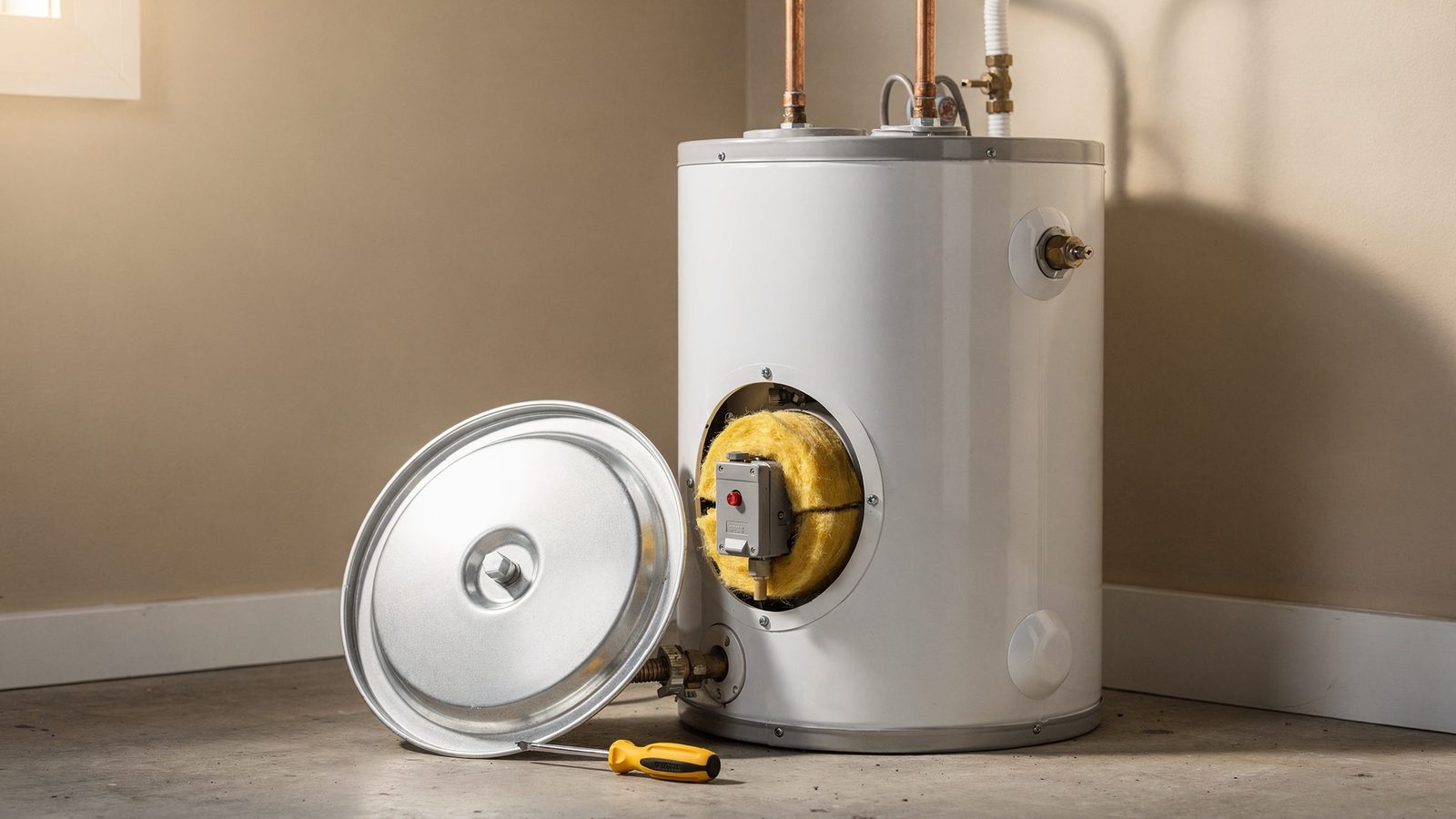
On an electric tank, check the breaker first, then the high-limit reset. Rheem's troubleshooting table lists a tripped breaker as a cause of no hot water and says to reset it 1. If the breaker holds and there is still no hot water, the safety control behind the access panel may have tripped. Rheem says it cuts power to the element when the water overheats and must be reset by hand 1.
Here is the safe order.
1. Find the water heater's breaker in your electrical panel. It is often a double breaker labeled "water heater." If it is tripped, switch it fully off, then on. 2. Give the tank time to heat, then test a hot tap. If the water warms, the breaker was the problem. If the breaker trips again, stop. A breaker that trips twice is telling you there is an electrical fault, and that is a call to a professional. 3. If the breaker never tripped, turn it off before opening anything. Rheem's reset procedure starts with "Turn off the power to the water heater" 2. 4. Remove the jacket access panel and pull back the insulation. Do not remove the thermostat's protective cover. Press the red RESET button 2. 5. Put the insulation and panel back before turning the power on 2.
There is one line in the manual that matters more than the button. Rheem says the cause of the high temperature "must be investigated by qualified service technician" before the heater goes back into service 1. The reset gets you hot water tonight. It does not tell you why the water overheated, and whatever caused it is still there. Book the check even if the reset works.
We will be direct about the risk. There are live electrical terminals behind that panel, and Rheem's own caution says not to attempt repair of wiring, thermostats, heating elements or other safety devices 3. If you are not certain the power is off, do not open it.
Gas heaters: ignition, lockout and the gas supply
On a gas tank, check three things in order: that gas is reaching the heater, that the burner is trying to light, and whether the control has locked out. A. O. Smith's power direct vent manual says its ignition control "will attempt to light the burner three times" and, if it does not detect ignition, enters lockout and flashes an error code 4. A locked-out heater stays cold until the cause is fixed.
Start with the easy ones. Is the gas valve on the supply line open, with the handle parallel to the pipe? Are your other gas appliances, like the range, working? If nothing in the house has gas, the problem is the gas service, not the heater.
Next, look at the control on the front of the heater. A. O. Smith's manual says its control flashes an error code when it locks out 4, and many modern gas heaters use a status light that blinks in a pattern. Count the blinks and match them to the chart on the heater's label or in its manual. The pattern tells you whether the heater sees a venting problem, a flame problem or a sensor fault.
Older gas heaters use a standing pilot instead of an electronic igniter. Those have their own lighting instructions printed on the tank. Follow the label for your exact model, because the steps differ by brand and age.
One rule overrides everything here. If you smell gas, do not try to light anything. Leave the house right away and call for help from outside. Our guide to what to do if you smell natural gas covers that in full.
If the heater locks out again after a reset, or the error code points at venting or the flame sensor, it needs a technician. Repeated lockouts are the control doing its job.
Tankless heaters: flow, error codes and winter sizing
A tankless heater only fires when water flows fast enough through it. Rinnai's spec sheet for the RUR98i lists a minimum activation flow rate of 0.4 gallons per minute and a minimum flow of 0.26 gallons per minute once running 56. A faucet barely cracked open, a clogged aerator or a dirty inlet filter can keep flow below that line, and the burner never lights.
Open a hot tap all the way and see whether the unit fires. If it does, your problem was low flow at that fixture. Clean the aerator or showerhead and test again.
Check the display. Most tankless units show a numbered error code when something stops them. Write the code down. It is the single most useful thing you can give a technician on the phone.
Check incoming pressure if hot water comes and goes. The same Rinnai sheet recommends 60 to 80 PSI of supply pressure for best performance 7. If your house reads well outside that range, tell the technician, because it changes the diagnosis.
Winter matters more for tankless than for tanks. The Department of Energy's building science guide says tankless sizing depends on the winter cold water temperature where you live 9. Colder incoming water means the unit has to raise the temperature further, so the same flow can come out cooler. Charleston Water System's 2025 report puts the year's average water temperature at 69.8 degrees Fahrenheit 10, but that is an annual average, so some months run colder. Rheem's troubleshooting table makes the same point for tanks: cold inlet water "takes longer to heat" in winter 3. A tankless unit sized at the edge shows it first.
When the tank is just recovering
Sometimes there is nothing wrong. A tank heater stores a fixed amount of hot water, and after a run of showers, a load of laundry and a dishwasher cycle, it can be empty. Rheem's troubleshooting table lists exactly this: water use "may have exceeded the capacity of the water heater," and the fix is to "Wait for the water heater to recover after an abnormal demand" 3.
This is a common false alarm on a busy morning or the first night guests stay over. Give the tank time to reheat, then test again without running anything else in between. The same Rheem table lists another simple cause worth ruling out: a thermostat set too low 3.
If the water heats back up, the heater is working. If it happens every day with normal use, the tank may now be too small for the household, or sediment and a failing element are cutting its real capacity. That is a sizing conversation, not an emergency.
One more pattern to know. Hot water that runs out much faster than it used to, with no change in how many people live in the house, means the tank is delivering less than it should. On an electric tank that can be a failing element, which is a repair for a technician, not a reset.
When the checks point to a repair or a replacement
Once the checks are done, you will know which of three situations you are in: it was a breaker, a reset or a recovery and it is fixed; it is a part that has failed, like an element, thermostat, igniter or sensor; or it is a heater at the end of its life. Age is the deciding factor between the last two.
The Department of Energy's building science guide says tank water heaters generally last 10 to 15 years and tankless units up to 20 8. Check the label on your tank for the manufacture date. A five-year-old tank with a failed element is a repair. A fourteen-year-old tank with the same failure is a candidate for replacement, because the next failure is close behind.
Here is what we publish about cost, so you can plan. At Blue Collars, a diagnosis starts at around $150 11. Water heater repairs are usually a few hundred dollars, and replacement runs into the low thousands 12. These are typical ranges from past work, not a quote and not a guarantee. What your job costs depends on what we find, and we give you the price for it before any work begins.
| What you found | Most likely cause | What to do next |
|---|---|---|
| Breaker tripped once, then held | Overload or a one-time fault | Let it heat, then watch it |
| Breaker trips again | Electrical fault in the element or wiring | Stop and call a plumber |
| Electric reset brought hot water back | Overheat cutoff tripped | Book a check; Rheem says the cause needs a technician |
| Gas control blinking a code | Venting, flame or sensor fault | Match the code, then call |
| Tankless fires only at full flow | Low flow or a dirty filter | Clean aerators and the inlet filter |
| Hot water returns after a wait | Tank was recovering | Nothing, or review tank size |
| Tank is past 10 to 15 years old | End of service life | Price a replacement before it floods |
If your heater is still cold after these checks, book a water heater visit and tell us what you tested. If you are weighing a replacement, our breakdown of what a water heater replacement costs in Charleston and our comparison of tank or tankless over ten years cover the numbers.
Where we stand on it
Many no hot water problems are not emergencies, and a homeowner can rule out the simple causes in a few minutes with the manual's own steps. We would rather you check the breaker before paying for a visit.
What we will not tell you is that a reset fixes anything. Rheem says the cause of an overheat needs a technician, a gas heater that keeps locking out is telling you something is wrong, and a tank past 10 to 15 years old is borrowing time 18. Do the checks. Then, if the water is still cold, call with what you found.
Common questions
Tap a question to see the answer.
Who wrote this
- SC license
- CLM 117414
- Charleston
- 2157 Rich Street, Ste 203, North Charleston, SC 29405
- Availability
- 24 hours, 7 days, live technician on the phone
- Veterans
- 10% off, mention it when you book
This page is written by the licensed contractor that does the work, not by a national cost aggregator. Every figure on it is either our own pricing or traced to a named primary source in the list below. Check our license before you book us, and before you book anyone else. More about Blue Collars.
Sources
Every figure on this page traces to a primary source. Verification dates are shown so you can see how current each one is.
- 1Rheem. Residential Electric Water Heater Use and Care Manual AP23124. April 2024. https://media.rheem.com/blobazrheem/wp-content/uploads/sites/36/2024/04/Residential-Electric-Side-Connect-Blanketed-Lowboy-UC-Manual-AP23124-1.pdf
- 2Rheem. Manual AP23124, reset procedure. April 2024. https://media.rheem.com/blobazrheem/wp-content/uploads/sites/36/2024/04/Residential-Electric-Side-Connect-Blanketed-Lowboy-UC-Manual-AP23124-1.pdf
- 3Rheem. Manual AP23124, troubleshooting. April 2024. https://media.rheem.com/blobazrheem/wp-content/uploads/sites/36/2024/04/Residential-Electric-Side-Connect-Blanketed-Lowboy-UC-Manual-AP23124-1.pdf
- 4A. O. Smith. GPD-40 Instruction Manual. 2013. https://assets.hotwater.com/damroot/Original/10004/GPD-40%20insturction%20manual.pdf
- 5Rinnai. RUR98i Specification Sheet. https://media.rinnai.us/salsify_asset/s-7ad5db21-f66e-4c02-a4fc-fda15a5ca0b1/RUR98i%20(KBP3237FFUD-US)%20SP.pdf
- 6Rinnai. RUR98i Specification Sheet. https://media.rinnai.us/salsify_asset/s-7ad5db21-f66e-4c02-a4fc-fda15a5ca0b1/RUR98i%20(KBP3237FFUD-US)%20SP.pdf
- 7Rinnai. RUR98i Specification Sheet. https://media.rinnai.us/salsify_asset/s-7ad5db21-f66e-4c02-a4fc-fda15a5ca0b1/RUR98i%20(KBP3237FFUD-US)%20SP.pdf
- 8U.S. Department of Energy, Building America Solution Center (PNNL), citing IBACOS 2012. Gas-Fired Tankless Water Heaters. August 2021. https://basc.pnnl.gov/resource-guides/gas-fired-tankless-water-heaters
- 9U.S. Department of Energy, Building America Solution Center (PNNL). Gas-Fired Tankless Water Heaters, equipment sizing. August 2021. https://basc.pnnl.gov/resource-guides/gas-fired-tankless-water-heaters
- 10Charleston Water System. 2025 Water Quality Report. May 2026. https://www.charlestonwater.com/DocumentCenter/View/3100/2025-Water-Quality-Report
- 11Blue Collars. Plumbing Services. Read October 2026. https://bluecollars.com/plumbing/
- 12Blue Collars. Water Heater Replacement Cost in Charleston SC. Read October 2026. https://bluecollars.com/blog/water-heater-replacement-cost-charleston-sc/
